A well-designed wooden play kitchen gives children a hands-on space for pretend cooking, serving, and everyday role-play. The best options balance sturdy construction with engaging details such as lights, sounds, storage, and adjustable features.
We selected 10 wooden play kitchens with different styles, sizes, and play features so you can find a practical match for your child, available space, and budget.
Best 10 Wooden Play Kitchens Picks for 2026
Best Adjustable Pick
Tiny Land Lights & Sounds Kitchen

- Three adjustable height settings for ages 3–8
- Lights, sounds, knobs, sink, and multiple play zones
- Includes 18 pieces of pretend food and cookware accessories
Best For: Growing children and compact play spaces
Best Feature-Rich Design

- Includes refrigerator, ice maker, coffee machine, juicer, and more
- Modern bean-green finish with gold handles
- Side handles aid room-to-room movement
Best For: Kids who want many pretend appliances
Best for Group Play

- 43-inch-wide design accommodates up to three children
- Coffee maker, ice maker, microwave, stove, sink, and more
- Includes storage areas and a 22-inch countertop
Best For: Siblings and cooperative preschool play
Best Value-Style Basics
Wooden Light-Up Pretend Kitchen

- Light-up design with multiple opening doors
- Storage space supports organization and tidy-up play
- Non-toxic wood with stated ASTM F963 and CPSIA compliance
Best For: Simple pretend cooking in a compact area
Best Traditional Cottage Pick

- Classic cream cottage styling with scalloped trim
- Includes microwave, oven, clicking knobs, and five accessories
- Open shelving provides convenient toy storage
Best For: Toddlers and young children who prefer traditional styling
Best Convertible Bistro Design
Tiny Land BistroSwitch Kitchen

- Slides between home-kitchen and bistro modes
- Includes menu board, guest check pad, and order pad
- Modern wood design with deep sink and display fridge
Best For: Children ages 4–8 who enjoy restaurant role-play
Best Interactive Feature Set
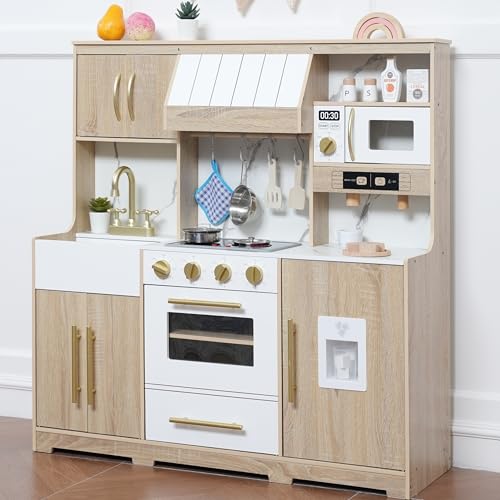
- Lights and sounds add realism to pretend cooking
- Includes 19 accessories and numerous play appliances
- Multiple storage areas help organize accessories
Best For: Children ages 3–8 who enjoy interactive pretend play
Best for Organized Independent Play
Tiny Land Wooden Play Kitchen with Storage

- Four felt bins and hooks support easy cleanup
- Roomy counter encourages two-child play
- Screen-free features promote open-ended imagination
Best For: Families wanting storage-focused, cooperative pretend play
Best for Interactive Group Play
Wooden Play Kitchen with Lights and Sounds

- Interactive stove includes lights and crackling sounds
- Large layout supports playdates and collaboration
- Includes 15-plus cooking and serving accessories
Best For: Children who enjoy sensory features and shared pretend play
Best for Realistic Kitchen Role-Play
Tiny Land Toddler Play Kitchen Set

- Multiple stations mirror everyday kitchen routines
- Storage cabinets and shelving encourage organization
- Interactive knobs, faucet, and ice dispenser add realism
Best For: Young children who enjoy detailed, hands-on pretend play
Best Adjustable Pick – Tiny Land Lights & Sounds Kitchen
For families comparing wooden play kitchens, this Tiny Land model stands out for its adjustable height and interactive details. Light-up stove elements, a range hood, turning knobs, and a removable sink create a more immersive setup, while the compact footprint suits playrooms or shared living spaces.
Best For: Growing children ages 3–8 who enjoy realistic pretend cooking in a space-conscious kitchen.
Pros:
- Three height settings accommodate growing children.
- Lights and sounds add realism to pretend play.
- Includes pretend food, cookware, dishes, utensils, chef hat, and apron.
- Wood construction, smooth edges, and stated ASTM F963 and EN71 compliance support safer play.
Cons:
- The mini design has a relatively narrow 11.8-inch depth.
- Assembly details are not provided in the supplied notes.
Its adjustable design gives this kitchen more staying power than a fixed-height model, while the included accessories help children start role-playing right away. Choose it when interactive features and flexibility matter more than a larger play surface.
Best Feature-Rich Design – ROBUD Green Corner Kitchen
This ROBUD wooden play kitchen is a strong option for children who want many appliances to explore. Its 31.3-inch width includes a refrigerator, ice maker, coffee machine, juicer, microwave, oven, dishwasher, and kitchen accessories, while the green-and-gold finish brings a decorative look to a play area.
Best For: Children ages 3 and up who enjoy varied appliance-themed pretend play.
Pros:
- Offers an unusually broad selection of pretend appliances and functions.
- Green finish and gold handles create a distinctive modern appearance.
- Smooth, burr-free surfaces and lightweight cookware are designed for comfortable play.
- Hollow side handles make the unit easier to move between rooms.
Cons:
- At 37.5 pounds, it is heavier than some smaller play kitchens.
- The 11.6-inch depth still requires dedicated floor space.
With its extensive appliance lineup, this is a good fit for children who may lose interest in simpler kitchens. Its substantial construction and broad feature set are appealing, but families should plan for a fairly heavy, full-size setup.
Best for Group Play – Tiny Land Modern Home Kitchen
Among wooden play kitchens, this Tiny Land model is especially suited to shared play because its larger 43-inch width is designed to accommodate up to three children. It combines a coffee maker, ice maker, microwave, stove, sink, cupboards, oven, clock, and weather table with a modern cream-white home-style design.
Best For: Siblings or preschool groups who need a roomy pretend kitchen for cooperative play.
Pros:
- Large operating area is designed for up to three children at once.
- Includes numerous interactive areas, including a coffee maker, ice maker, microwave, and stove.
- Offers a 22-inch countertop height and ample storage areas.
- Wood materials are stated to surpass ASTM F963 and EN71 safety testing requirements.
Cons:
- The 43-inch width needs more floor space than compact kitchens.
- The supplied age details are inconsistent, listing both toddler use and a 36-month–3-year recommendation.
- A temporary odor may be present after unpacking, according to the seller.
This is the practical choice when multiple children need room to play together. Measure carefully before buying, since its generous operating area is also its main space requirement.
Best Value-Style Basics – Wooden Light-Up Pretend Kitchen
This wooden play kitchen keeps the focus on familiar pretend-cooking activities while adding a built-in light. Opening oven, cabinet, freezer, refrigerator, and microwave doors, along with included cooking utensils and storage space, gives children several ways to practice role-play and tidying routines.
Best For: Children ages 3 and up who want a straightforward modern kitchen with light-up play.
Pros:
- Built-in light and opening appliance doors support realistic pretend play.
- Storage space encourages children to organize accessories.
- Made from non-toxic wood and stated to comply with ASTM F963 and CPSIA standards.
- Its 9.44-inch depth may work well where floor space is limited.
Cons:
- Assembly requires a screwdriver.
- The supplied notes do not specify the number or full contents of the kitchenware accessories.
- The 31.2-inch depth measurement is listed inconsistently with the stated dimensions, so buyers should verify the footprint.
This model is a sensible pick for families seeking core kitchen features without the larger footprint of some wide playsets. Confirm the dimensions and allow time for assembly before choosing it for a small room.
Best Traditional Cottage Pick – Cottage Play Kitchen
For shoppers seeking wooden play kitchens with classic styling, this cream cottage model combines scalloped trim with practical pretend-play features. It includes a microwave, oven, clicking knobs, open storage, and five cooking accessories in a compact footprint.
Best For: Toddlers and young children who want a traditional-looking kitchen with straightforward features and built-in storage.
Pros:
- Charming cottage design with scalloped details and a cream finish
- Includes a play microwave, oven, interactive clicking knobs, and five accessories
- Open pantry, oven, and sink shelving helps store pretend-food accessories
- Uses ASTM- and CPSIA-certified engineered wood with metal components
Cons:
- Assembly involves dozens of screws and fasteners
- At 23 pounds, it may be less substantial than heavier wooden models
- Its 24-by-12-by-36-inch footprint still requires dedicated floor space
This is a practical choice if traditional styling and basic kitchen play matter more than electronics or a large accessory collection. Plan extra time for assembly before introducing it to your child.
Best Convertible Bistro Design – Tiny Land BistroSwitch Kitchen
This Tiny Land option stands out among wooden play kitchens because its sliding panel changes the setup from a home kitchen to a pretend bistro. Its modern cream finish, stainless-steel pots, deep sink, display fridge, and restaurant-play accessories support more varied storytelling.
Best For: Children ages 4–8 who enjoy restaurant role-play, serving others, and switching between home and cafe scenarios.
Pros:
- 2-in-1 design shifts between home-kitchen and bistro play
- Includes a magnetic menu board, guest check pad, and 40-page order pad
- Features a deep 3.2-liter sink, clear display fridge, and four-compartment prep station
- Solid Hemu wood pillars and a 20.2-inch prep counter support active play
Cons:
- Its 39.3-inch height may be less suitable for smaller toddlers
- The 31.8-inch width and 12.3-inch depth require a relatively large setup area
- The notes do not specify a complete accessory count beyond the role-play components listed
This is the most flexible pick of the three for children who like social, imaginative play. The bistro conversion adds variety, while the modern wood design may blend more easily into shared living spaces.
Best Interactive Feature Set – inFUNSAME Modern Play Kitchen
For families prioritizing realistic interaction, this modern wooden play kitchen adds lights and sounds to a broad selection of pretend appliances. The setup includes a glowing induction cooker, refrigerator, ice machine, microwave, oven, coffee maker, sink, storage, and 19 accessories.
Best For: Children ages 3–8 who want electronic cooking effects, multiple play zones, and plenty of accessories.
Pros:
- Built-in lights and sounds create a more immersive pretend-cooking experience
- Includes 19 accessories plus an ice machine, coffee maker, microwave, oven, and sink
- Storage includes spice racks, refrigerator space, oven space, and cabinets
- Heavy-duty MDF construction is certified to ASTM F963 and CPSIA standards
Cons:
- At 48 pounds, it is considerably heavier than the other listed options
- Assembly is recommended for two adults
- Its 38.6-by-11.5-by-39.8-inch size may be tall for younger children
This model offers the broadest combination of appliances, effects, and accessories in the roundup. It is a strong fit when interactive details and organized storage are worth the added weight and assembly effort.
Best for Organized Independent Play – Tiny Land Wooden Play Kitchen with Storage
For families seeking wooden play kitchens that encourage both pretend cooking and cleanup habits, this Tiny Land model combines a roomy countertop with accessible storage. Its soft modern design also makes it easier to fit into shared family spaces.
Best For: Children who enjoy cooperative pretend play and families prioritizing built-in organization.
Pros:
- Clear acrylic cabinet doors, four removable felt bins, and hooks help children sort and store accessories.
- The 31 x 12-inch countertop provides room for two children or a child and parent to play together.
- Clickable knobs, a rotating faucet, oven, cupboards, pots, and utensils support open-ended role-play without electronic sounds.
- Rounded edges, water-based paint, BPA-free materials, and ASTM F963 and EN71 compliance add reassurance.
Cons:
- The sink is for pretend play and has no running water.
- Its approximately 30-inch width and 40-inch height require a dedicated play area.
This is a practical choice when storage and screen-free imaginative play matter as much as the kitchen features. The included cookware and child-accessible bins make it ready for play and tidying from the start.
Best for Interactive Group Play – Wooden Play Kitchen with Lights and Sounds
This wooden play kitchen stands out among wooden play kitchens for its interactive stove lights and crackling sounds. Its larger layout and broad accessory set are designed for social pretend cooking, playdates, and parent-child activities.
Best For: Children who prefer electronic-style sensory features and families planning group play.
Pros:
- The stove lights up and makes crackling sounds, while the oven knob clicks for added realism.
- Its approximately 35.8-inch width provides space for children to play together.
- Includes a stove, sink, oven, coffee maker, ice maker, cabinets, shelves, and 15-plus accessories.
- Non-toxic wood, rounded edges, and ASTM F963 and CPSIA compliance support a safety-conscious design.
Cons:
- Lights and sounds may not suit families seeking completely screen-free, non-electronic play.
- At nearly 20 kilograms, it is comparatively heavy to move once assembled.
- The larger footprint requires more floor space than compact play kitchens.
Choose this model if realistic sensory details and a social setup are high priorities. The extensive cooking accessories and multiple stations give several children ways to participate at once.
Best for Realistic Kitchen Role-Play – Tiny Land Toddler Play Kitchen Set
For shoppers comparing wooden play kitchens with realistic layouts, this Tiny Land set creates distinct zones for cooking, washing, baking, and making pretend coffee. Open shelving and cabinets add useful storage while reinforcing everyday kitchen routines.
Best For: Toddlers and young children who enjoy detailed role-play and learning through hands-on routines.
Pros:
- Includes a stovetop, sink, microwave, oven, ice dispenser, coffee station, and open shelving.
- Clicking knobs, a turning faucet, and a pretend ice dispenser add interactive detail.
- Built-in cabinets and shelves provide space for toy food, cookware, and accessories.
- Natural wood, water-based paint, rounded edges, numbered parts, and ASTM and CPSIA compliance support everyday use.
Cons:
- The included-components details specifically list two wooden ice cubes, so additional accessories may need to be supplied separately.
- Its 31.89-inch width and 31.5-inch height still require dedicated floor space.
- The realistic multi-station design may take longer to assemble than a simpler playset.
This model is a strong fit when children are drawn to realistic household routines rather than a single pretend cooking surface. Its storage and varied activity zones give imaginative play several directions while encouraging organization.
How We Picked These Wooden Play Kitchens
We focused on play kitchens that offer a useful combination of construction quality, imaginative-play value, safety-conscious design, and everyday practicality. The selection includes compact toddler-friendly models, larger sets with storage, and feature-rich kitchens with lights, sounds, curtains, or convertible layouts.
We also considered whether each design provides meaningful play zones—such as a sink, cooktop, oven, microwave, shelving, or serving counter—rather than adding features that make the set unnecessarily complicated. Product dimensions, assembly requirements, included accessories, and battery-powered functions are important details to verify before ordering.
Quick Comparison
| Best For | Look For |
|---|---|
| Realistic pretend play | Lights, sounds, knobs, and appliance-style details |
| Small spaces | Compact footprints, vertical storage, or bistro-style designs |
| Growing children | Adjustable-height counters or flexible configurations |
| Organized playrooms | Shelves, cabinets, hooks, and included storage |
| Style-conscious homes | Modern, cottage, neutral, or fabric-accented designs |
Key Buying Factors for Wooden Play Kitchens
Size and Layout
Measure the available floor and wall space before choosing a set. A larger kitchen may provide more realistic zones, but a compact model can be easier to place in a bedroom or shared play area. Check the assembled dimensions, not only the package size.
Materials and Stability
Look for solid-feeling panels, smooth finished edges, dependable hinges, and a stable base. Wall anchoring may be recommended for taller models. Because assembly quality affects stability, allow time to tighten and recheck all hardware.
Features and Batteries
Lights and sounds can make role-play more engaging, but they also require batteries and may be less suitable for children who prefer quiet play. Confirm which features are functional, whether batteries are included, and how accessible the controls are.
Storage and Accessories
Built-in shelves, cabinets, hooks, and bins help children keep pretend cookware organized. Check what accessories come with the set and whether the storage areas are large enough for the items your child already owns.
Age and Supervision
Follow the manufacturer’s recommended age range and inspect the product for small parts, loose hardware, or damaged components. Young children should use the kitchen with appropriate supervision, especially when accessories or battery compartments are involved.
Who Should Buy Which Wooden Play Kitchens?
Choose an adjustable-height model if you want a kitchen that can accommodate a growing child. Feature-rich light-and-sound designs suit children who enjoy realistic sensory play, while simpler sets are often better for open-ended storytelling and quieter rooms.
For limited space, consider a compact or 2-in-1 bistro-style kitchen. Families prioritizing organization should choose a design with substantial storage. If appearance matters in a shared living area, modern, neutral, or cottage-inspired finishes may blend more easily with existing décor. Whichever model you choose, prioritize a stable construction, suitable dimensions, and features your child will actually use.