Choosing a dependable encoder does not have to mean spending thousands of dollars. The best streaming encoders under $500 can convert HDMI or SDI video into compatible network streams for YouTube, Facebook Live, IPTV, remote production, and more.
This roundup focuses on practical features that matter at this price: resolution, codec support, streaming protocols, audio handling, connectivity, and ease of setup.
Best 10 Streaming Encoders Under 500 Picks for 2026
Flexible Multi-Platform Encoder
URayCoder HDMI H.265/H.264 Encoder

- 1080p at up to 60 fps
- Supports four protocol-based output streams
- Adds overlays and accepts HDMI or line-in audio
Best For: Multi-platform HDMI streaming and IPTV workflows
Compact 4K Workflow Hub
Zowietek ZowieBox Streaming Encoder

- Supports 4K HDMI workflows
- Converts HDMI to NDI|HX3/HX2/HX
- Includes zero-lag passthrough and PoE support
Best For: Gaming, NDI production, and portable IP video setups
SDI Camera Specialist
LILLIPUT SE1117 Streaming Encoder

- SDI input with SDI loop output
- H.264/H.265 encoding up to 1080p60
- Supports standalone streaming and dual streams
Best For: SDI cameras and computer-free event streaming
4K Storage-Ready Encoder
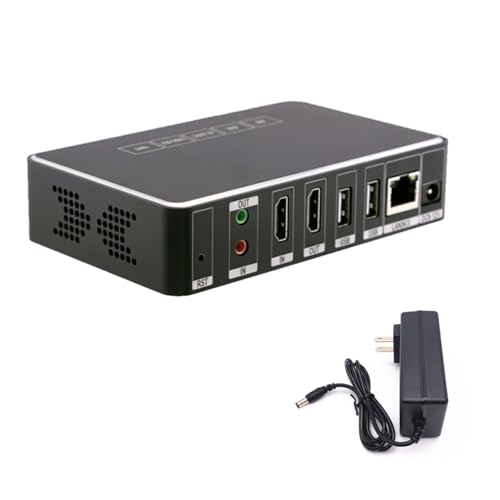
- Supports 4K video at 30 fps
- Includes 2GB RAM and 8GB flash storage
- Works with RTSP, RTMP, HLS, UDP, SRT, and NDI
Best For: 4K HDMI streaming with onboard network video storage
Best for Audio-Integrated Streaming
J-Tech Digital HDMI H.264 Encoder

- 1080p60 video broadcasting
- HDMI video with analog audio embedding
- Four-platform simultaneous streaming
Best For: Live events and mixer-based broadcasts
Best 4K DisplayPort Pick
UNISHEEN 4K30 Streaming Encoder

- 4K30 input and output support
- Four streams with separate protocols
- H.264/H.265 and overlay tools
Best For: DisplayPort-based 4K multi-server broadcasts
Best for Protocol Flexibility
URayCoder 4K HEVC HDMI Encoder
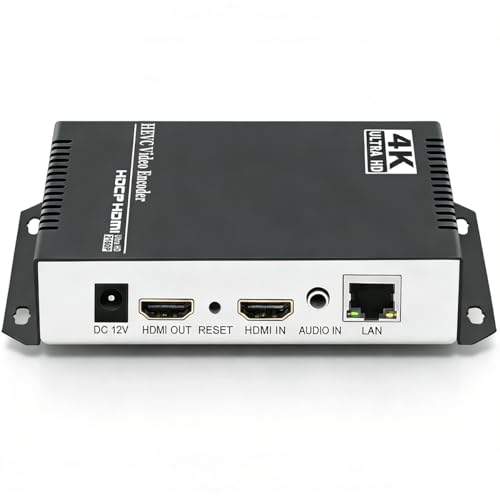
- 4K30 and up to 120 fps at lower resolutions
- Broad H.264/H.265 protocol compatibility
- Four simultaneous configurable outputs
Best For: Advanced HDMI multi-platform streaming systems
Most Versatile 4K Encoder

- 4K@30 hardware encoding with H.264/H.265
- Dual streams and broad protocol support
- Includes decoding, multi-view, OSD, and recording
Best For: Churches, classrooms, IPTV, and live event installations
Best Compact 1080p60 Pick

- Hardware encoding up to 1080P60
- Browser-based setup without PC software
- Compact design with broad IP protocol support
Best For: 1080p live streaming, signage, and remote monitoring
Best for Multi-Platform Output

- 4K@30 H.265/H.264 encoding
- Up to four protocol outputs simultaneously
- Includes overlays, audio options, and video adjustments
Best For: Multi-platform broadcasts and customizable IPTV streams
Flexible Multi-Platform Encoder – URayCoder HDMI H.265/H.264 Encoder
For shoppers comparing streaming encoders under 500, this URayCoder model is a versatile HDMI-to-IP option for 1080p live production. It supports H.265/H.264 encoding, multiple streaming protocols, and simultaneous output to as many as four streams.
Best For: YouTube, Facebook, Twitch, OBS, IPTV, and multi-platform HDMI streaming.
Pros:
- Supports 1080p input and output at up to 60 fps.
- Works with RTSP, RTMP(S), SRT, HLS, UDP, RTP, ONVIF, and other protocols.
- Offers text, scrolling captions, logos, timestamps, cropping, rotation, and mirroring.
- Accepts HDMI-embedded or 3.5mm line-in audio.
Cons:
- It is limited to HDMI input rather than SDI or other camera connections.
- The listed maximum resolution is 1080p, not 4K.
This is a strong choice when protocol flexibility and customization matter more than 4K capture. Its web-based management and multi-stream capability make it practical for creators and small production setups.
Compact 4K Workflow Hub – Zowietek ZowieBox Streaming Encoder
Among streaming encoders under 500, the Zowietek ZowieBox stands out for combining 4K HDMI handling with IP encoding and decoding. Its compact enclosure supports RTMP(S), RTSP, SRT, NDI workflows, and zero-lag HDMI passthrough for gaming and live production.
Best For: Console gaming, NDI-based production, PTZ camera workflows, and compact professional streaming kits.
Pros:
- Handles capture up to 4K and provides zero-lag HDMI passthrough.
- Supports NDI|HX3, NDI|HX2, NDI|HX, SRT, RTMP(S), and RTSP.
- Can operate as an encoder or decoder for flexible IP-to-HDMI workflows.
- Offers USB-C power, PoE, DC output, web control, and tripod mounting.
Cons:
- Encoder and decoder modes cannot run simultaneously.
- Full NDI signals are not supported.
- USB capture card functionality is not currently supported.
The ZowieBox is a particularly capable option for users who need more than a basic HDMI streamer. Its NDI conversion, passthrough, and multiple power choices add flexibility, though its mode limitations should be checked against the planned workflow.
SDI Camera Specialist – LILLIPUT SE1117 Streaming Encoder
For buyers seeking streaming encoders under 500 for SDI cameras, the LILLIPUT SE1117 provides a focused 1080p solution. It encodes SDI video with H.264 or H.265, includes SDI loop-through, and can stream without requiring a connected computer.
Best For: SDI cameras, live events, broadcast-style installations, and computer-free streaming.
Pros:
- Provides one SDI input and one SDI loop output for local monitoring or signal pass-through.
- Supports H.264/H.265 encoding up to 1080p at 60 Hz.
- Handles RTSP, RTP, RTMPS, RTMP, HTTP, UDP, SRT, unicast, and multicast.
- Supports dual streaming, overlays, mirroring, and upside-down image adjustment.
Cons:
- It is designed around SDI rather than HDMI input.
- Its listed maximum resolution is 1080p.
The SE1117 makes the most sense when SDI compatibility is a priority. Its loop output and standalone operation suit camera operators and event teams that need a straightforward network streaming path without adding a computer.
4K Storage-Ready Encoder – youyeetoo Link Pi ENC1-V3
If you are comparing streaming encoders under 500 and want 4K capability with onboard storage, the youyeetoo Link Pi ENC1-V3 is worth considering. Its quad-core processor, 2GB of RAM, and 8GB of flash storage support HDMI encoding, network video storage, and several IP streaming methods.
Best For: 4K YouTube streaming, NDI/SRT-compatible setups, content sharing, and surveillance recording.
Pros:
- Supports 4K video at up to 30 fps.
- Provides 2GB of RAM and 8GB of onboard flash storage.
- Works with H.264 and H.265/HEVC encoding.
- Supports RTSP, RTMP, HLS, UDP, SRT, and NDI-compatible workflows.
Cons:
- The supplied details do not specify frame rates beyond 4K at 30 fps.
- Its HDMI-focused design may not suit SDI camera systems.
- The listed warranty is one year.
The ENC1-V3 is a practical fit for users who want 4K streaming plus local storage in one device. Its protocol range is useful for mixed network environments, while the HDMI connection keeps the setup oriented toward compatible consumer and production sources.
Best for Audio-Integrated Streaming – J-Tech Digital HDMI H.264 Encoder
For streaming encoders under 500, the J-Tech Digital HDMI H.264 encoder is a practical choice when you need 1080p60 streaming, flexible protocols, and a direct way to combine HDMI video with analog mixer audio. It can also send a stream to up to four platforms at once.
Best For: Live events, presentations, and broadcasts that need audio-board integration and multi-platform streaming.
Pros:
- Supports up to 1080p at 60Hz.
- Combines HDMI video with analog audio from a mixer or other source.
- Supports RTSP, RTP, RTMPS, RTMP, HTTP, UDP, and TS protocols.
- Offers four-platform simultaneous broadcasting and mobile control through the J-Tech Digital app.
Cons:
- Maximum listed broadcast resolution is 1080p, rather than 4K.
- Its analog-audio integration may be unnecessary for simple HDMI-only setups.
This encoder stands out for event production workflows where dependable audio routing and branded stream elements matter. The app-based controls, customizable on-screen display, and one-year manufacturer replacement warranty add practical value for ongoing use.
Best 4K DisplayPort Pick – UNISHEEN 4K30 Streaming Encoder
Among streaming encoders under 500, this UNISHEEN model is suited to users starting with a DisplayPort source and wanting 4K output. It supports H.264 and H.265 encoding, four simultaneous streams, and a broad selection of network protocols.
Best For: 4K30 DisplayPort workflows, multi-server broadcasting, and streams needing on-screen text or image overlays.
Pros:
- Supports 3840×2160 video at up to 30 fps.
- Can output four video streams simultaneously, with different protocols for each.
- Supports SRT, RTSP, RTMPS, UDP, NVR, H.264, and H.265.
- Includes de-interlacing, image enhancement, noise reduction, cropping, rotation, mirroring, and PNG or text overlays.
Cons:
- Uses a DisplayPort/type-C connection, so compatibility with HDMI-only sources may require additional hardware.
- Its listed maximum 4K frame rate is 30 fps.
This is a strong fit when resolution and protocol flexibility take priority. The ability to push separate streams to multiple servers is useful for distribution, while the OSD tools support captions, timing, and copyright information.
Best for Protocol Flexibility – URayCoder 4K HEVC HDMI Encoder
For buyers comparing streaming encoders under 500, the URayCoder 4K HDMI encoder offers an unusually broad protocol list and flexible video controls. It supports H.265 and H.264, 4K input and output at 30 fps, and higher frame rates at 2K and lower resolutions.
Best For: Advanced HDMI streaming setups that need multi-platform output, configurable overlays, and extensive protocol support.
Pros:
- Supports 4K at up to 30 fps and up to 120 fps at 2K and lower resolutions.
- Offers H.265/H.264 encoding and protocols including RTSP, RTMPS, SRT, HLS, WebRTC, UDP, FLV, and ICECAST.
- Can output four streams with different protocols simultaneously.
- Supports logos, scrolling captions, timestamps, cropping, rotation, mirroring, and HDMI or line-in audio.
Cons:
- Its extensive settings and protocol options may be more than basic users need.
- 4K streaming is limited to a maximum listed frame rate of 30 fps.
This model is the most adaptable option in the group for complex streaming and distribution requirements. Its Ethernet-based transmission, browser or mobile management, real-time stream-status viewing, and stated lifetime support make it appealing for more demanding installations.
Most Versatile 4K Encoder – 4K HDMI Encoder Decoder
For shoppers comparing streaming encoders under 500, this 4K model stands out as a flexible encoder-decoder for live production, IPTV, and multi-view setups. It accepts HDMI video up to 4K at 30fps, supports H.264 and H.265, and can stream through protocols including RTMP, RTSP, SRT, HLS, and UDP Multicast.
Best For: Churches, classrooms, event producers, IPTV deployments, and control rooms needing encoding, decoding, recording, and display flexibility in one unit.
Pros:
- Encodes HDMI input up to 4K@30 with H.264 or H.265 hardware processing.
- Supports two concurrent streams with independently configurable resolutions.
- Combines network decoding, HDMI loopout, multi-view layouts, OSD overlays, and USB or network recording.
- Compact all-metal chassis is rated for continuous operation.
Cons:
- Its extensive settings and protocol support may require networking knowledge.
- 4K capture and output are limited to 30fps.
- The generic branding provides less product-specific information than established broadcast brands.
This is the strongest all-around option when a basic streaming box is not enough. Choose it for installations that benefit from decoding, multi-screen display, recording, and professional overlays as well as straightforward live streaming.
Best Compact 1080p60 Pick – BM1000 HDMI Streaming Encoder
Among streaming encoders under 500, the UNISHEEN BM1000 is a practical choice for smooth 1080p live video without adding a computer to the setup. Its dedicated hardware supports H.265 and H.264 encoding at up to 1080P60, while browser-based configuration keeps deployment relatively simple.
Best For: YouTube or Facebook Live, remote monitoring, digital signage, IPTV, and compact installations using a 1080p HDMI source.
Pros:
- Delivers hardware-encoded 1080P60 video using H.265 or H.264.
- Supports RTMP(S), RTSP, SRT, UDP, HTTP, HLS, WebRTC, and additional streaming protocols.
- Browser setup requires no dedicated software, drivers, or operating-system compatibility.
- Compact design includes HDMI audio, external 3.5mm audio input, and OSD overlays.
Cons:
- It is designed for 1080p rather than 4K streaming.
- Advanced configurations still require basic networking knowledge.
- The listing specifies a 12V DC power requirement and does not include a power plug.
The BM1000 makes the most sense when 1080P60 is sufficient and space, setup time, and low-complexity operation matter more than 4K capability. Its protocol range also gives it useful flexibility for streaming and IP distribution.
Best for Multi-Platform Output – URayCoder 4K HEVC Encoder
For buyers seeking streaming encoders under 500 with extensive output options, this URayCoder model supports 4K input and output at up to 30fps, plus H.265/H.264 encoding. Its ability to output up to four streams using different protocols makes it suited to distributing one HDMI source across multiple platforms or systems.
Best For: Multi-platform broadcasters, content producers, IPTV operators, and users who need customizable overlays, audio inputs, and flexible stream delivery.
Pros:
- Supports 4K@30 input and output, with up to 120fps at 2K and lower resolutions.
- Can output up to four streams using protocols such as RTMP, RTSP, SRT, HLS, HTTP, and WebRTC.
- Offers text, scrolling captions, logos, timestamps, cropping, rotation, flipping, and mirroring.
- Supports HDMI-embedded and line-in audio with adjustable sound quality.
Cons:
- 4K operation is limited to 30fps.
- The single HDMI port may be restrictive for more complex signal-routing setups.
- Its many customization and networking options may take time to configure.
This model is a strong fit when simultaneous distribution and stream customization are priorities. It is more feature-rich than a basic HDMI-to-RTMP adapter, particularly for users managing several destinations or branded live content.
How We Picked the Best Streaming Encoders Under 500
We compared these 10 models according to the capabilities most likely to affect real-world streaming. Priority went to support for H.264 and H.265 encoding, useful output resolutions, stable wired networking, and broad protocol compatibility. We also considered whether each unit supports HDMI or SDI input, loop-through, NDI, SRT, RTMP, RTSP, HLS, or IPTV workflows.
Because specifications and firmware features can vary by model or seller, verify the current listing before buying—especially when you need 4K, 60fps, NDI, embedded audio, or WebRTC support.
Quick Comparison
Basic HDMI-to-IP encoders are typically the simplest and most affordable choice for a single camera or media source. Models with H.265 can reduce bandwidth and storage requirements, while H.264 remains the safest option for broad platform compatibility.
4K-capable units are useful when you need higher-resolution production or want to preserve detail for downstream workflows, but check whether 4K applies to input, passthrough, or encoded output. SDI models are better suited to professional cameras and longer cable runs. Encoder/decoder combinations and NDI-capable devices offer more flexibility for network production but may require additional configuration.
Key Buying Factors for Streaming Encoders Under 500
Input and Output Resolution
Match the encoder to your source. A 1080p60 model is often sufficient for live events, teaching, gaming, and social video. Choose 4K only if your camera, network, platform, and production workflow can use it.
Codec and Protocol Support
H.264 provides wide compatibility with streaming services and receivers. H.265 can deliver similar image quality at a lower bitrate, but not every platform or playback device accepts it. RTMP is common for online platforms; RTSP, UDP, HLS, SRT, and NDI are more useful for production, distribution, or private networks.
Connectivity and Audio
Confirm the connector type before ordering. HDMI suits most consumer and mirrorless cameras, while SDI is standard in many professional environments. Look for audio embedding, 3.5mm input support, HDMI audio handling, and a loop output if you need local monitoring.
Network and Setup Requirements
Wired Ethernet is generally more dependable than wireless connectivity for continuous streams. Review the control method, web interface, app support, bitrate controls, and whether the encoder can save multiple stream destinations. SRT support is particularly valuable for unstable or long-distance connections.
Who Should Buy Which Streaming Encoders Under 500?
- Single-camera streamers: Choose a straightforward HDMI encoder with H.264, RTMP, and a simple web or app interface.
- Professional camera users: Select an SDI model when your camera and infrastructure use SDI cabling.
- 4K creators: Pick a 4K-capable encoder only after confirming the required frame rate, codec, and platform support.
- Network production teams: Consider NDI, SRT, multicast, or encoder/decoder functionality for flexible routing.
- IPTV and private distribution users: Prioritize RTSP, UDP, HLS, and configurable bitrate options over social-platform presets.
For most buyers, the best value comes from matching the encoder to the input source and delivery protocol rather than choosing the highest advertised resolution.