Choosing among streaming encoders with HDMI can be difficult when specifications, supported protocols, resolution limits, and production features vary widely. The right model depends on whether you need a simple HDMI-to-IP bridge, a portable 4K encoder, or a multi-input system for more demanding live production.
This roundup compares ten options across resolution, codec support, connectivity, streaming protocols, recording, and workflow flexibility so you can select an encoder that fits your equipment and distribution platform.
Best 10 Streaming Encoders with Hdmi Picks for 2026
Flexible Full-HD Streamer

- 1080p at up to 60fps
- Up to four protocol outputs
- HDMI and line-in audio
Best For: Full HD multi-platform streaming and IPTV
Professional 4K Production Hub

- HDMI and SDI inputs
- 4K H.264 or HEVC encoding
- Streams to up to six destinations
Best For: Broadcast and multi-source live production
High-Frame-Rate 4K Encoder
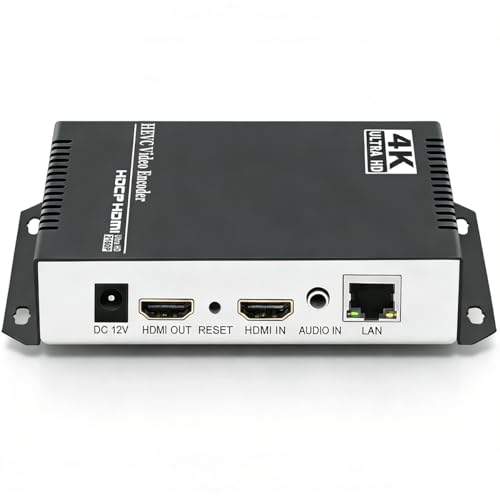
- 4K up to 30fps
- Up to 120fps at 2K or lower
- Four simultaneous protocol outputs
Best For: 4K streaming and high-frame-rate content
Compact 4K Pass-Through Encoder
Magewell Ultra Encode HDMI Plus

- 4K HDMI encoding at 30fps
- HDMI loop-through output
- 128GB internal recording storage
Best For: Compact HDMI live-production and monitoring workflows
Multi-Channel Pick
ORIVISION 4K 4-Channel Encoder

- Four HDMI channels with mixed 4K30 and 1080p60 support
- Up to 16 simultaneous feeds
- Broad protocol support and built-in LCD
Best For: Multi-camera broadcasts and IPTV deployments
Professional Broadcast Pick
Blackmagic Streaming Encoder 4K
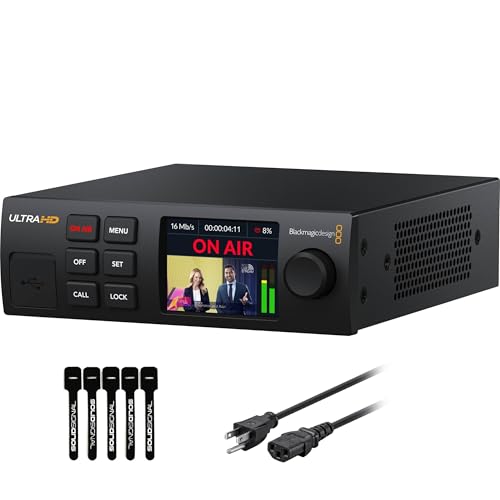
- Encodes up to 2160p60 in H.264 or H.265
- 12G-SDI input with standards conversion
- Ethernet, mobile failover, monitoring, and webcam output
Best For: SDI-based broadcast and control-room productions
Flexible Single-Source Pick

- 4K30 HDMI-to-IP encoding in H.265 or H.264
- Up to four simultaneous protocol outputs
- Includes overlays, captions, logo, and image controls
Best For: Single-camera streaming and customizable IPTV output
Best Compact 1080p Encoder
1080p60 HDMI Streaming Encoder

- H.264/H.265 hardware encoding at 1080p60
- Broad RTMP, RTSP, SRT, HLS, and WebRTC support
- Browser setup with audio and OSD overlay options
Best For: Compact 1080p live streaming and monitoring installations
Best for Multi-Stream 4K Workflows
Multi-Channel 4K HDMI IP Encoder
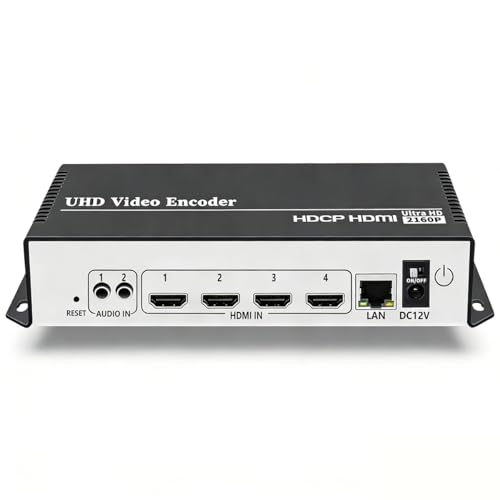
- 4K input and output at up to 30 fps
- Outputs up to four streams simultaneously
- Supports extensive protocols, overlays, and audio options
Best For: Multi-platform livestreaming and professional IP video distribution
Best Flexible 4K Protocol Encoder
4K HDMI HEVC Streaming Encoder

- 4K H.265/H.264 encoding at up to 30 fps
- Wide protocol support for IPTV and streaming servers
- Built-in overlay and video-adjustment controls
Best For: Flexible 4K HDMI-to-IP streaming and IPTV installations
Flexible Full-HD Streamer – URayCoder H.265 HDMI Encoder
For buyers comparing streaming encoders with hdmi, this URayCoder model is a practical Full HD option for converting an HDMI source into network streams. It supports 1080p at up to 60fps, H.265/H.264 encoding, HDMI or 3.5mm line-in audio, and multiple streaming protocols.
Best For: Full HD livestreaming, IPTV, OBS setups, and users who need multi-platform output and customizable overlays.
Pros:
- Supports 1080p video at up to 60fps with H.265 and H.264 encoding.
- Can output up to four streams using protocols including RTMP(S), RTSP, HLS, UDP, and SRT.
- Offers text, logo, timestamp, cropping, rotation, and mirroring tools.
- Accepts HDMI-embedded or 3.5mm line-in audio.
Cons:
- Limited to Full HD rather than 4K input or output.
- Its extensive configuration options may require time to learn.
This is a versatile choice when reliable 1080p delivery matters more than 4K resolution. The lifetime warranty and technical support may also appeal to organizations planning custom or longer-term deployments.
Professional 4K Production Hub – Magewell Ultra Encode AIO
This Magewell is a high-end option among streaming encoders with hdmi, combining HDMI and SDI inputs in one standalone unit. It supports 4K encoding, dual-input layouts, simultaneous recording, and streaming to multiple destinations for more demanding live-production workflows.
Best For: Broadcast, event, and studio productions that need HDMI/SDI flexibility, 4K support, and integrated recording.
Pros:
- Accepts HDMI or SDI and can combine both with picture-in-picture or side-by-side layouts.
- Supports 4K encoding with H.264 or HEVC compression.
- Streams to up to six destinations using protocols such as RTMP(S), SRT, NDI|HX, and HLS.
- Records to SD card, USB storage, or network drives while streaming.
Cons:
- Its 3.6-pound rack-mountable design is less compact than simple encoder boxes.
- Professional features may be more than casual streamers need.
Choose the Ultra Encode AIO when your workflow includes multiple source types or simultaneous recording and distribution. PoE, Wi-Fi, 4G modem support, web control, API access, and an LCD add deployment flexibility.
High-Frame-Rate 4K Encoder – URayCoder HDMI IP Encoder
For streaming encoders with hdmi that need 4K capability, this URayCoder model supports 3840×2160 input and output at up to 30fps, plus up to 120fps at 2K and lower resolutions. It also provides broad protocol support and built-in tools for branded, multi-platform streams.
Best For: 4K source streaming, high-frame-rate 2K content, and users distributing to several platforms or server types.
Pros:
- Supports 4K video at up to 30fps and up to 120fps at 2K or lower.
- Handles RTMP(S), RTSP, HLS, SRT, WebRTC, TRTC, Icecast, and other protocols.
- Can output up to four streams with different protocols simultaneously.
- Includes overlays, audio selection, cropping, rotation, and mirroring controls.
Cons:
- 4K operation is limited to 30fps.
- The supplied details do not specify the complete physical dimensions or warranty terms.
This encoder is a strong fit when 4K input and flexible distribution are priorities. Its high-frame-rate support at lower resolutions also makes it useful for smoother sports, gaming, or other motion-focused content.
Compact 4K Pass-Through Encoder – Magewell Ultra Encode HDMI Plus
This compact Magewell is a polished choice among streaming encoders with hdmi, adding 4K encoding, HDMI loop-through, onboard recording, and NDI|HX support. It is designed for camera, switcher, gaming, education, corporate AV, and event workflows where local monitoring or pass-through is useful.
Best For: HDMI-based live production that needs 4K encoding, local display pass-through, and recording without a separate recorder.
Pros:
- Encodes HDMI sources up to 4096×2160p30 and provides HDMI loop-through.
- Supports RTMP(S), SRT, NDI|HX, HLS, and TS over UDP/RTP.
- Records while streaming to its 128GB internal storage, USB storage, or network locations.
- Includes PoE, Wi-Fi, 4G/5G modem support, web control, API access, and an on-device display.
Cons:
- 4K encoding is limited to 30fps.
- 4G/5G USB modems are supported but not supplied.
The HDMI loop-through is the key advantage for setups that need a local monitor or downstream display while streaming. Its integrated storage and scheduling features further reduce the need for separate production hardware.
Multi-Channel Pick – ORIVISION 4K 4-Channel Encoder
For buyers comparing streaming encoders with hdmi, the ORIVISION ZY-EH1304 stands out for its four-channel design. It accepts up to two 4K30 inputs plus two 1080p60 inputs, and can distribute channels to multiple platforms using a broad selection of streaming protocols.
Best For: Multi-camera broadcasts, IPTV systems, CATV head-ends, and users who need simultaneous multi-platform output.
Pros:
- Four HDMI inputs and outputs with support for up to two 4K30 and two 1080p60 sources.
- Can send up to 16 feeds simultaneously across supported protocols and platforms.
- Supports H.265, H.264, and MJPEG, plus RTMP, RTMPS, SRT, RTSP, HLS, UDP, RTP, and HTTP.
- Built-in LCD status screen, OSD overlays, mirror/flip controls, and one-year warranty.
Cons:
- Its multi-channel feature set may be more than needed for a simple one-camera stream.
- Network streaming setup may require technical configuration and troubleshooting.
This is the most flexible choice here for production environments that need several HDMI sources and many simultaneous destinations. Its four-channel capacity is useful, but buyers seeking a compact, single-input encoder may prefer a simpler design.
Professional Broadcast Pick – Blackmagic Streaming Encoder 4K
Among streaming encoders with hdmi, the Blackmagic Streaming Encoder 4K is aimed at professional SDI workflows rather than basic HDMI capture. It encodes up to 2160p60 in H.264 or H.265, while providing HDMI monitoring, Ethernet connectivity, and mobile failover.
Best For: Broadcast teams using 12G-SDI cameras, professional control-room workflows, and productions that need resilient connectivity.
Pros:
- Supports HD and Ultra HD encoding up to 2160p60 in H.264 and H.265.
- 12G-SDI input with loop output and automatic standards conversion.
- Ethernet and USB-C smartphone tethering with automatic connection failover.
- Includes HDMI and SDI monitor outputs, closed-caption support, REST API control, and USB-C webcam outputs.
Cons:
- The primary video input is SDI, so it is not a direct HDMI-input encoder.
- Its professional features and 1/3 RU form factor may be excessive for casual streaming.
This is the strongest option for a broadcast-oriented setup where SDI, redundancy, monitoring, and remote production features matter. HDMI is available for monitoring, but buyers needing direct HDMI source encoding should look at the other options.
Flexible Single-Source Pick – URayCoder 4K HDMI Encoder
The URayCoder is a practical choice for shoppers seeking streaming encoders with hdmi in a compact box. It converts an HDMI source into network streams, supports 4K input at up to 30fps, and offers extensive protocol compatibility for platforms, IPTV, and local network workflows.
Best For: Single-source HDMI streaming, YouTube or Facebook broadcasts, IPTV distribution, and customizable branded streams.
Pros:
- Supports 4K input and output at up to 30fps, with up to 120fps at 2K and lower resolutions.
- Supports H.265 and H.264 plus RTSP, RTMP(S), SRT, HLS, UDP, RTP, ONVIF, WebRTC, and other protocols.
- Can output up to four streams with different protocols simultaneously.
- Provides text, scrolling caption, logo, timestamp, cropping, rotation, flip, and mirror controls.
Cons:
- It is designed around a single HDMI source rather than multiple physical inputs.
- 4K operation is limited to 30fps.
This encoder balances a broad feature set with straightforward HDMI-to-network conversion. It is a good fit when you want flexible stream destinations and branding tools without the four-input complexity of the ORIVISION unit.
Best Compact 1080p Encoder – 1080p60 HDMI Streaming Encoder
For buyers comparing streaming encoders with HDMI, this compact UNISHEEN model focuses on reliable 1080p60 hardware encoding without requiring PC software. It supports H.264 and H.265, offers browser-based setup, and works with a broad range of IP streaming protocols.
Best For: Live events, remote monitoring, IPTV, digital signage, and users who need a small encoder for 1080p HDMI sources.
Pros:
- Hardware H.264/H.265 encoding supports 1080p at 60 fps.
- Supports RTMP(S), RTSP, SRT, HLS, WebRTC, UDP, and additional protocols.
- Browser-based configuration requires no dedicated software or drivers.
- Includes HDMI embedded audio, 3.5mm audio input, and OSD overlays for text, logos, or timestamps.
Cons:
- It is limited to 1080p output rather than 4K.
- Advanced configurations may require basic networking knowledge.
- The power specification lists 12V DC and a 42-watt nominal rating, so power compatibility should be checked before purchase.
The BM1000 is a practical choice when 1080p60 is sufficient and easy browser management matters more than 4K support. Its compact enclosure and wide protocol compatibility make it flexible for fixed installations and continuous operation.
Best for Multi-Stream 4K Workflows – Multi-Channel 4K HDMI IP Encoder
This URayCoder unit stands out among streaming encoders with HDMI for multi-platform and higher-resolution workflows. It accepts 4K HDMI input, supports H.264/H.265 encoding, and can output up to four streams using different protocols.
Best For: Professional livestreaming, IPTV, enterprise video distribution, and users who want to send one HDMI source to multiple platforms or services.
Pros:
- Supports 4K UHD at up to 30 fps and up to 120 fps at 2K and lower resolutions.
- Can simultaneously output four streams using different protocols.
- Works with HTTP, RTSP, RTMP(S), SRT, HLS, WebRTC, multicast, and other formats.
- Offers captions, logos, timestamps, video adjustments, and HDMI or line-in audio.
Cons:
- 4K capture and output are limited to 30 fps.
- Its larger feature set may be more than needed for a simple single-platform stream.
- Only one HDMI connector is listed in the supplied specifications.
Choose this model if simultaneous distribution and flexible protocol support are priorities. Its 4K capability and customizable overlays make it better suited to production and network-distribution environments than basic home streaming.
Best Flexible 4K Protocol Encoder – 4K HDMI HEVC Streaming Encoder
For buyers seeking streaming encoders with HDMI and broad network compatibility, this URayCoder model combines 4K HDMI encoding with H.265/H.264 support. It is designed for IPTV, streaming servers, and platforms such as YouTube and Facebook Live.
Best For: 4K HDMI-to-IP streaming, IPTV deployments, streaming-server integration, and users who need configurable video overlays and network outputs.
Pros:
- Supports 4K UHD at up to 30 fps and up to 120 fps at 2K or lower resolutions.
- Provides RTSP, RTMP(S), HTTP, UDP, HLS, SRT, WebRTC, and other protocol options.
- Supports static text, scrolling captions, logos, timestamps, cropping, rotation, and mirroring.
- Accepts HDMI embedded audio and line-in audio with adjustable sound quality.
Cons:
- 4K operation is capped at 30 fps.
- The supplied details list one HDMI connector, which may not suit multi-input setups.
- Its advanced configuration options may be unnecessary for straightforward streaming needs.
This encoder is a strong fit when 4K support and protocol flexibility matter more than a minimal feature set. It offers useful production controls and lifetime warranty and technical support according to the supplied product information.
How We Picked the Best Streaming Encoders with Hdmi
We focused on the features that matter most in real-world streaming setups: HDMI input compatibility, maximum resolution and frame rate, H.264 or H.265 encoding, supported output protocols, network connectivity, and setup flexibility. Models supporting standards such as RTMP, RTMPS, RTSP, SRT, HLS, UDP, or WebRTC can serve a wider range of platforms and local video systems.
We also considered practical extras, including loop-through outputs, NDI support, PoE, onboard recording, audio handling, multichannel input, and compatibility with IPTV or video-management workflows. Because requirements vary substantially, the list includes both straightforward single-channel encoders and more advanced production-oriented hardware.
Quick Comparison
For a basic HDMI-to-network conversion, a compact 1080p encoder may be sufficient and easier to configure. If you need 4K capture, choose a model that explicitly supports the required 4K frame rates and codec. Production-focused options may add SDI, HDMI loop-through, NDI, recording, dual-input mixing, or multiple simultaneous feeds.
Protocol support is equally important. RTMP or RTMPS is common for social platforms, while SRT is useful when reliability is important across unpredictable networks. RTSP, UDP, HLS, WebRTC, and multicast are often more relevant to surveillance, IPTV, internal distribution, and browser-based applications.
Key Buying Factors for Streaming Encoders with Hdmi
Resolution, Frame Rate, and Codec
Confirm that the encoder supports your source signal, such as 1080p60 or 4K, rather than relying only on a headline resolution. H.264 offers broad compatibility, while H.265 can reduce bandwidth and storage requirements but may not work with every destination.
Inputs, Outputs, and Audio
Check the HDMI version, input count, audio support, and whether the device provides loop-through output. A loop-through connection lets you send the source to a monitor or switcher without adding another splitter. Multi-input models are better suited to installations requiring several feeds or switching.
Streaming Protocols and Network Connection
Match the encoder’s protocols to your destination before buying. Ethernet is generally preferable for stable live video, while Wi-Fi or mobile connectivity can help with field production. Look for SRT when network conditions are variable and RTMPS when sending securely to supported platforms.
Recording and Production Features
Onboard recording, NDI, PoE, video mixing, and redundant outputs can simplify a professional workflow. These features add value only if you will use them, so avoid paying for production capabilities when a basic point-to-point stream is all you need.
Who Should Buy Which Streaming Encoders with Hdmi?
Choose a compact 1080p encoder for webinars, classrooms, churches, security cameras, and simple YouTube or Facebook streams. Choose a 4K HDMI model for higher-resolution cameras, event production, or workflows that need a clearer source for recording and distribution.
Choose an encoder with SRT, recording, NDI, or loop-through when reliability and integration with other production equipment matter. Choose a multichannel encoder for IPTV systems, control rooms, or installations that need several HDMI sources handled from one device. Before purchasing, verify the destination platform, required resolution, network type, and connector compatibility.